
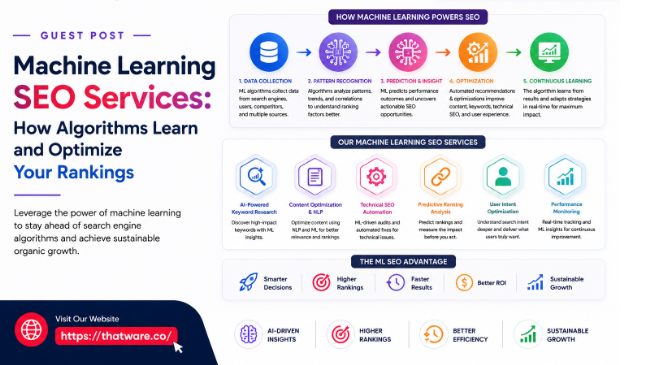
There’s a particular kind of frustration that comes with modern SEO. You do the work — the audits, the content, the links — and then an algorithm update happens, and rankings move for reasons that aren’t immediately obvious. Sometimes you gain from it; more often, at least for a while, you lose something. And the honest answer about why is usually “we’re not entirely sure which signal shifted.”
Machine learning doesn’t fix this completely. But it changes the nature of how you operate within it. When ML is genuinely integrated into an SEO strategy, you stop trying to reverse-engineer a static set of rules and start building toward the dynamic patterns the algorithm is actually trying to find. That’s a different game, and it tends to produce more durable results.
What Machine Learning Is Actually Doing
Let’s ground this in something concrete. Machine learning, at its core, is a method of finding patterns in large datasets that humans couldn’t identify manually. A model is trained on examples, learns to distinguish signals from noise, and then applies that learning to new data.
In SEO, this plays out in several distinct ways. Ranking models can be trained on the characteristics of pages that perform well vs. poorly for specific query types — identifying which signals most predict success in a given competitive landscape. Content models can learn the semantic structures present in high-ranking content, producing briefs that reflect what’s actually working rather than what worked a year ago. Anomaly detection systems can flag pages showing early signs of ranking decay before they’ve fully fallen.
Each of these is doing something that manual analysis — even very good manual analysis — cannot do at scale. The patterns are too numerous and too subtle, the data too large.
How Rankings Are Actually Learned
When someone talks about machine learning SEO services, the most important thing to understand is that these systems are learning from real-world ranking data, not from speculation about what Google rewards. The training data is actual search results, actual user behavior signals, actual page performance metrics — and the models are finding the correlations between these things.
This matters because it cuts through a lot of industry noise. SEO Twitter debates endlessly about whether X signal matters or Y factor is overrated. A well-trained ML model doesn’t care about the debate — it looks at what’s actually correlated with ranking performance across large samples and reports what it finds. That’s a very different quality of insight than expert intuition, even when the expert is genuinely good.
Competitive Intelligence at Scale
One of the places where ML SEO services create the most immediate value is competitive analysis. Traditional competitive research involves picking two or three competitors, analyzing their top pages, noting what they’re doing, and trying to improve on it. It’s useful but limited — you’re sampling, not analyzing.
ML-powered competitive analysis can evaluate the full content strategy of entire competitive landscapes — hundreds of competitors, thousands of pages — and identify the patterns that consistently outperform. What entities do the top-ranking pages in your space establish? What content structures appear in positions one through three but rarely in positions eight through ten? What depth of coverage on adjacent topics correlates with ranking for the primary query?
This kind of analysis at scale reveals competitive dynamics that sampling-based research simply misses. And it tells you not just what the top pages are doing, but what they’re doing differently — which is the actually useful piece of information.
Content Optimization That Actually Learns
The term “AI content optimization” gets thrown around loosely, and a lot of what calls itself that is basically just a more sophisticated keyword density tool. Genuine ML-powered optimization does something meaningfully different.
Real AI-powered SEO optimization learns from the relationship between content characteristics and ranking outcomes over time. If pages with a certain semantic structure, at a certain depth, addressing a certain breadth of related entities tend to rank better for a query type — the system identifies that pattern and applies it to new optimization recommendations. And because it continues learning as new data comes in, its recommendations improve over time rather than becoming stale.
This is genuinely different from “add these three keywords to your page” advice. It’s a continuously updating model of what effective content looks like in your specific competitive context.
Technical Prioritization Through Predictive Modeling
Another high-value application is predictive technical triage. Standard technical audits generate long lists of issues ranked by severity — critical errors, warnings, notices — without much guidance on which fixes will actually improve rankings.
ML models trained on the correlation between technical characteristics and ranking outcomes can predict which technical changes will produce the most meaningful ranking movement for a given site. Fix this crawl budget issue, and pages in this section of the site will likely see indexation improvements. Address this Core Web Vitals problem on these specific page templates, and expect improved rankings for the queries with strong competition in that area.
This changes how development resources get allocated, often significantly. The work that gets prioritized is the work most likely to produce organic traffic growth, not just the work that shows up as red in a crawl report.
The Learning Curve Is Worth It
Getting the most out of ML-powered SEO services requires some adjustment in expectations. These systems don’t produce overnight transformations — they produce compounding improvements as data accumulates and models become more calibrated to your specific domain and competitive landscape. The first month of ML-informed optimization looks less dramatic than a sudden technical fix might. But at month six, the trajectory is usually substantially steeper than what traditional approaches produce.
That compounding curve is the point. Machine learning earns its place in SEO not by doing individual tasks faster, but by building a progressively more accurate model of what works for your specific situation — and applying that model consistently, at a scale and speed that human teams simply can’t match.
